捕捉绿光
Catching the Green Ray
在孤独与清明之间
一项海边放映提案,以独处、变化的日光和聆听组织观看影像的体验。
- 署名
- 黄露瑶
- 黄露瑶的职责
- 策展方案及个人署名影像的剪辑
- 项目语境
- 中国阿那亚 · 拟议场地
- 媒介
- 展览设计 · 影像
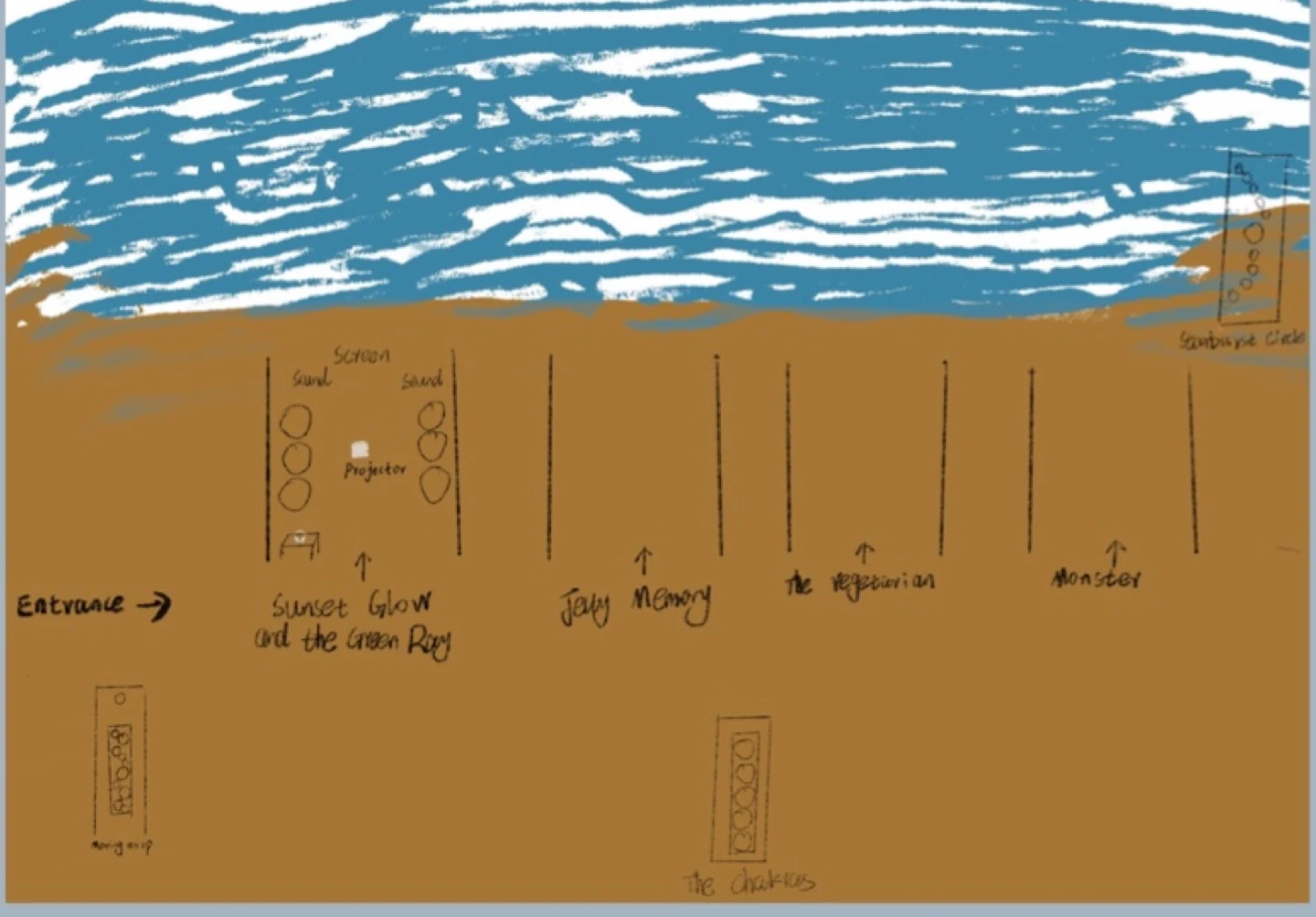
四处观看空间
方案在海滩上设想四处半开放空间。每处呈现一件影像,提供相对安静的观看环境,同时保留海的视线或声响。户外场地还拟陈列一组雕塑。
辨认自己的瞬间
侯麦的《绿光》开启了一条关于等待与自我辨认的线索。拟选作品包括黄露瑶的《果冻记忆》,以及一件把侯麦电影片段与窦唯音乐并置的剪辑研究。
英文原文
黄露瑶 · 策展提案原文节选
Concept
What is the green ray? For me, it’s not a cosmic sign or a promise of love. It is a fleeting moment of self-recognition—not being understood by others, but by myself. A fragile shift when I stop avoiding the past and begin to see it clearly. It’s not a dramatic revelation, but a quiet pause that nonetheless changes everything. This exhibition revolves around that moment. Inspired by Éric Rohmer’s Le Rayon Vert, I saw myself in Delphine—sensitive, uncertain, and misaligned with the world around her. She longs for something real, but can’t articulate it. That same emotional undercurrent echoes in Dou Wei’s song Sunset Glow, which mentions a “green ray” and carries a soft, drifting melancholy. The exhibition features four moving image works. Two are my own: Jelly Memory and Sunset Glow and the Green Ray. They attempt to visualize internal states—emotions that hesitate, dissolve, remain unspoken. The other two works, The Vegetarian and Monster, echo this emotional landscape of solitude, confusion, and the slow search for clarity. I chose moving images because they stretch time. They make space for silence, uncertainty, and those almost-invisible shifts that define emotional transformation. This is not an exhibition about the green ray itself, but about the kind of person who waits for it— and maybe, just for a moment, sees it. The exhibition is set by the sea: a place that reflects the film’s final scene, and where I often rediscover that quiet clarity.
Exhibition space
Aranya, China The exhibition takes place on a beach in Aranya, China—a coastal cultural site known for its open-air theatre, minimalist architecture, and strong connection to nature. This setting is open, vulnerable, and full of quiet transitions, just like the emotional tone of the works. To address the technical needs of projection and sound while preserving the connection with nature, four small semi-enclosed structures will be built directly on the sand. Each structure hosts one video work, providing shade, sound isolation, and a space for private reflection. The sea remains visible and audible in the distance—just enough to remind viewers of time passing, of stillness and movement. This setting rejects the control of the white cube. It invites viewers to sit, stay, listen—not to rush. It mirrors the gentle moment of clarity that the “green ray” represents. Seaside EXhibition, Aranya Seaside Theater, Aranya theater festival Aranya flim festival