当照护成为控制
When Care Becomes Control
从保护、保存与引导出发,考察展览如何塑造观众的行动和选择。
- 署名
- 黄露瑶
- 黄露瑶的职责
- 策展方案与空间叙事设计
- 项目语境
- 里沃利城堡 · 拟议场地,策展研究 II 课程
- 媒介
- 展览设计
展览空间中的照护
方案把城堡受到保护的建筑纳入展览论述。保护与引导规定了观众可以靠多近、可以走到哪里,又被期待如何行动。
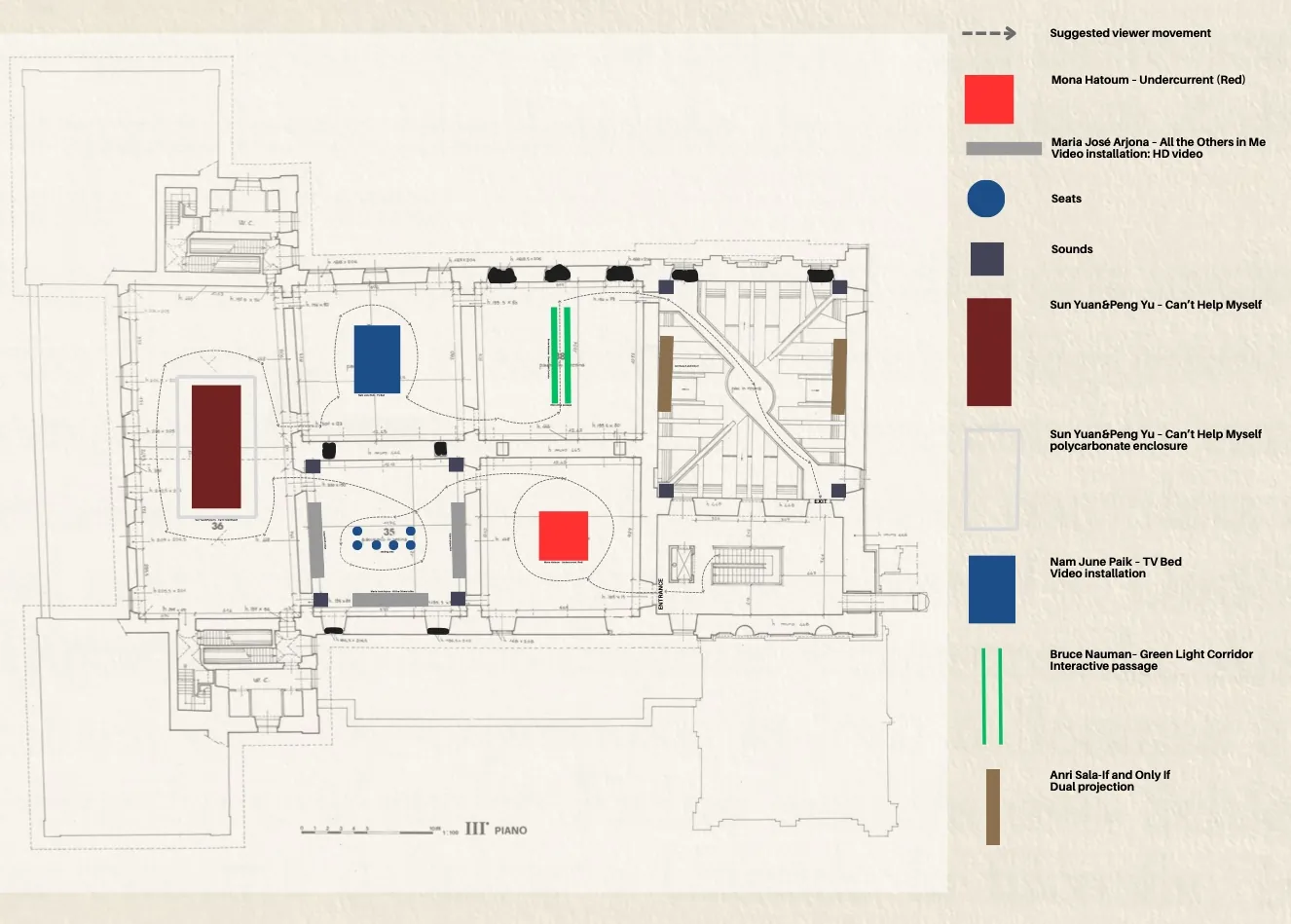
串联六件作品的动线
拟议动线从莫娜·哈透姆的《Undercurrent (Red)》延伸至安利·萨拉的《If and Only If》,经过身体受到不同限制的情境,收束于一件围绕倾听与调整展开的作品。
英文原文
黄露瑶 · 课程策展提案原文节选
Curatorial text
When Care Becomes Control examines forms of power that do not rely on prohibition or violence, but instead function through protection, concern, and responsibility. In contemporary institutions, care is often presented as a neutral or benevolent necessity: artworks must be protected, historical architecture preserved, visitors guided and kept safe. Yet these gestures of care also establish boundaries, hierarchies, and patterns of behavior that visitors internalize almost unconsciously. This exhibition takes place at Castello di Rivoli, a site where care is inseparable from history. The building itself — a centuries-old castle marked by military use, destruction, and restoration — requires constant protection. Floors cannot be marked, walls cannot be altered, structures cannot be touched freely. Light is filtered through specific materials, movement is guided along prescribed paths, and access to certain areas is limited. These restrictions are justified not as authority, but as necessity. They are presented as acts of care toward the building, the artworks, and the public. Rather than resisting these constraints, the exhibition uses them as its conceptual foundation. The project asks: at what point does care begin to discipline behavior? How do protective systems produce self-regulation, caution, and obedience? And how does power become most effective when it no longer appears as power at all? Visitors entering the exhibition are immediately positioned within a system of protection. The architecture itself demands careful movement. The historical value of the site encourages silence, slowness, and respect. This atmosphere produces a form of behavioral adjustment: visitors lower their voices, become attentive to their bodies, and anticipate rules even before encountering them explicitly. Care, here, is not enforced — it is felt. The exhibition unfolds progressively across the third floor, moving from spaces where rules appear implicit to spaces where control becomes increasingly visible. Early rooms emphasize subtle forms of guidance: spatial arrangements that slow movement, materials that signal fragility, and conditions that suggest caution without instruction. As visitors proceed, these mechanisms become more explicit, confronting them with systems that limit access, restrict interaction, or place objects deliberately beyond reach. This gradual progression mirrors the way power often operates in everyday life. Control rarely announces itself as domination. Instead, it is embedded in routines, protocols, and expectations framed as necessary for collective well-being. In institutional contexts — particularly those concerned with preservation and education — obedience is often produced through care. The exhibition is particularly attentive to its audience. Castello di Rivoli has a strong commitment to engaging younger visitors and children, positioning contemporary art as something to be encountered early rather than deferred. For younger audiences, systems of care are often the first forms of authority they encounter: instructions meant to protect, guide, or teach. By foregrounding these mechanisms within the exhibition space, the project invites visitors of different ages to recognize how power is learned, embodied, and normalized. Importantly, the exhibition does not aim to accuse care of being inherently oppressive. Instead, it seeks to expose its ambivalence. Care can be necessary, ethical, and genuinely protective. Yet it can also function as a tool for regulation, producing conformity and limiting agency under the guise of responsibility. By making these dynamics perceptible rather than invisible, the exhibition encourages critical reflection on how institutions shape behavior — and how visitors participate in that process. Ultimately, When Care Becomes Control proposes the exhibition space itself as both subject and medium. The castle is not merely a container for artworks, but an active participant in the production of meaning. Through its rules, materials, and architecture, it demonstrates how power operates most effectively when it is internalized. The exhibition asks visitors not only to observe artworks, but to observe themselves — their movements, hesitations, and compliance — as part of a system that feels caring, protective, and quietly authoritative.
Relevance and context
This exhibition investigates how care, protection, and intimacy can gradually evolve into systems of control. Beginning with fragile domestic space and moving through bodily exposure, automation, technological mediation, and architectural restriction, the spatial progression mirrors contemporary conditions in which power operates through subtle, everyday mechanisms rather than visible coercion. The sequence of rooms is designed so that visitors do not simply understand this transformation intellectually, but experience it physically through movement, proximity, and spatial limitation. The project is particularly resonant within the context of Castello di Rivoli. Housed in a historic architectural structure shaped by layers of authority and preservation, the museum itself embodies forms of institutional care that simultaneously frame and regulate behavior. The constraints of the third floor — protected flooring, fixed circulation routes, and structural limitations — are not neutral parameters but active agents that influence perception and bodily orientation. In this sense, the building becomes an extension of the exhibition’s inquiry, reinforcing its exploration of how environments subtly condition conduct. The curatorial approach draws inspiration from exhibition models that foreground spatial sequencing and embodied tension. Retrospectives of Bruce Nauman, for example, heighten perceptual thresholds through architectural intervention, while works by Hito Steyerl and Anri Sala critically engage with technological mediation and institutional space. Rather than presenting crisis as spectacle, this exhibition focuses on how systems are internalized — how control emerges not through dramatic rupture, but through repetition, intimacy, and spatial design. Hito Steyerl, Hell Yeah We Fuck Die, 2016 Installation view, Castello di Rivoli Conceived as a potential element within the Museum’s program, the exhibition aligns with Castello’s commitment to contemporary critical discourse while offering younger audiences an immersive environment in which to reflect on how structures of care and authority shape everyday life.